October 19, 2026
Our children’s early years are essential for developing strong, confident language skills. In a Montessori environment, we pay particular attention to how we nurture both receptive language (what children hear and understand) and expressive language (how they communicate their thoughts and feelings).
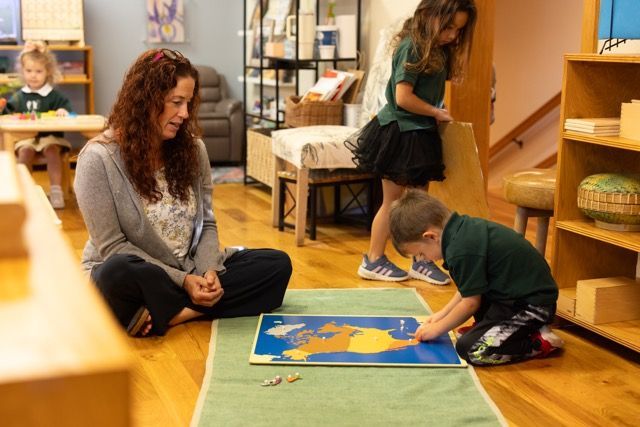
If you walk through our Primary environments at OakHaven Montessori School, you might not immediately notice the spoken language curriculum on the shelves. Unlike the colorful math beads or geography maps, many of our oral language exercises take the form of games, shared stories, and rich conversations.
Yet, these spoken language activities are woven seamlessly into the daily rhythm of our school day, laying the groundwork for reading, writing, and clear self-expression.
The Purpose Behind the Words
A young child’s vocabulary expands at an astonishing rate: from recognizing around 50 words at age one, to roughly 1,000 words by age three, and reaching 10,000 words or more by age five!
Because children absorb language effortlessly from their surroundings, we provide expansive vocabulary enrichment through mindful, intentional oral exercises.
We also recognize that the adult is the most important language material in the room. Our AMI-trained Guides (teachers) use precise, rich, and beautiful language when communicating with children. Whether we are naming the anatomical parts of a leaf or describing the steps of an activity, we offer full and accurate terms because we know we are building an essential foundation for life.
How We Keep Language Alive in the Classroom
Oral language at OakHaven is active, joyful, and deeply social. Here are a few of the purposeful activities you will see happening across our environments:
- Classified Picture Books: We choose wordless picture books centered around familiar themes or daily routines (such as a child’s morning sequence). A Guide sits with a child to take a "picture walk," encouraging the child to interpret the visual clues. Instead of telling the story, the Guide asks open-ended questions, helping the child develop expressive skills while laying the groundwork for story comprehension.
- True Stories: We gather small groups of children to share true stories about everyday life, history, art, music, or biology, often accompanied by real-world objects or cultural artifacts. Because young children under six are grounding themselves in reality, these true stories ignite their imagination while expanding their understanding of the world.
- The Question Game: After a shared experience, like a nature walk on our Dardenne Prairie campus, a Guide gathers a group to ask a series of ordered questions. As children share their thoughts, the Guide helps them structure their answers into complete sentences and summarizes the experience into a cohesive story. This activity builds auditory memory and directly prepares children for creative writing.
- Conversation at a Picture: Children gather around a fine art print on display in the classroom. The Guide prompts observation using "w" questions ("What do you see?", "Why do you think the person is sitting there?"). Once the children share their observations, the guide summarizes their thoughts into a small, narrative reflection.
- Reading Literature and Reciting Poetry: We share quality children's literature daily, always emphasizing the title, author, and illustrator. We also recite poetry from memory over several days. Children naturally absorb the rhythm, rhyme, and phonetic patterns, which supports their early reading development.
- Command Games ("Listen and Do"): To build auditory memory and processing skills, guides play "listen and do" games. It begins with simple, one-step actions ("Touch the bookshelf" or "Walk to the window") and expands to complex multi-step commands ("Find a friend, shake their hand, and choose a book for the table").
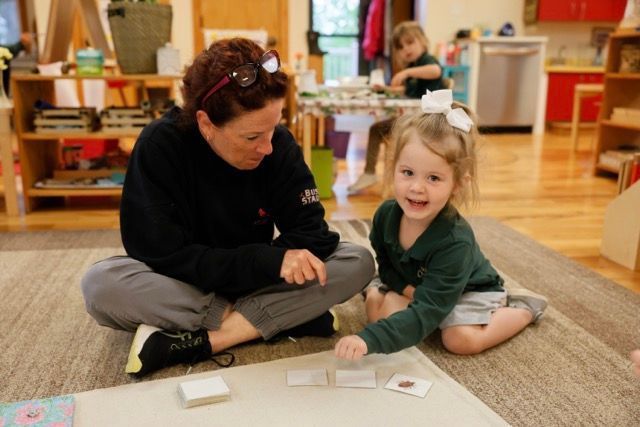
- Classified Pictures: Using structured collections of cards, from types of transportation to precise botanical terms like the parts of a flower, Guides help children categorize their world. Naming these classifications establishes mental order and enriches technical vocabulary.
- The Sound Game: Long before children pick up a pencil to write, we play an "I Spy" style game using small objects on a tray to isolate phonemes (the individual sounds in words). We start with initial sounds ("I spy something on the tray that starts with 'b'"), moving later to ending and medial sounds. This builds fundamental phonemic awareness in a playful, pressure-free way.
Building Confidence Beyond the Page
Spoken language activities do far more than prepare children to read and write. They teach children how to listen attentively, process complex information, and structure their thoughts logically.
Above all, our Guides take the time to listen patiently to each child's spontaneous efforts to express themselves. When children know their words are heard and valued, they gain true confidence in speaking, a skill that serves them far beyond the classroom walls.
Hear the Language of OakHaven in Action
Watching young children use rich vocabulary, articulate their needs, and engage in thoughtful conversation is one of the most rewarding aspects of a Montessori education.
We would love to
invite you onto campus to observe
our Primary and Elementary classrooms in action and hear the vibrant language community our children and Guides build together.