August 10, 2026
In our daily adult lives, we move through dozens of routines without giving them a second thought: washing the dishes, setting the dinner table, wiping down a counter, or tidying up a living room. For us, these are simply tasks to be completed. But for a young child, these exact moments hold an incredible, almost magnetic fascination.
Children have a natural, deeply rooted yearning to participate in the practical matters of daily life. They delight in doing real, meaningful work alongside the adults they admire most.
In the Montessori approach, we refer to these foundational activities as Practical Life. Whether a child is learning to scrub a table, wipe up a spilled drink, or water a classroom plant, these actions do far more than just keep an environment clean. They offer a gentle, purposeful introduction to daily responsibilities while supporting the child's internal motivation, intellect, and physical coordination.
Two Purposes: One External, One Internal
Every Practical Life activity we offer at OakHaven serves two distinct purposes.
The first is external and easily visible. When a child scrubs a table in our Primary environment, the table becomes clean. When they sweep the floor, the wood shavings disappear.
The second purpose is internal, invisible, and profoundly meaningful. Through this work, the child grows in confidence, independence, and a deep sense of belonging.
When children are invited to participate in purposeful work, they realize they are important, contributing members of their community. Learning to meet their own needs—such as dressing themselves, preparing a snack, or restoring a workspace—fosters a deep sense of pride and personal competence.
Over time, these small but significant experiences lay the essential groundwork for future independence. This is the very heart of what we mean by "Education for Life." By honoring their capability today, we prepare them to navigate their futures with confidence and care.
Preparing the Environment for Success
In our OakHaven environments, Practical Life activities are intentionally prepared and beautifully presented to support the child's natural drive for independence.
Everything is scaled to the child's physical dimensions. The sinks are at their height. The soap dispensers hold just enough soap for a single, successful handwash. Every tool has a specific, designated home on the shelf, and the children learn how to use and return each item with care.
This thoughtful preparation allows children to successfully take on tasks that might typically be done for them by well-meaning adults.
Even for our youngest children, this participation begins as a collaborative journey. When a child is transitioning into a new routine, our Guides might say, "I’m going to help you with your sleeve. Let’s slide your arm through together," ensuring they feel active and involved in the process. As they grow, they begin to take full ownership of these tasks.
Growth isn't always linear, and some days a child will need more reassurance than others. On those days, we simply offer a collaborative bridge: "Let's do this together," while still honoring the child's role in the work.
Real Work, Real Contributions
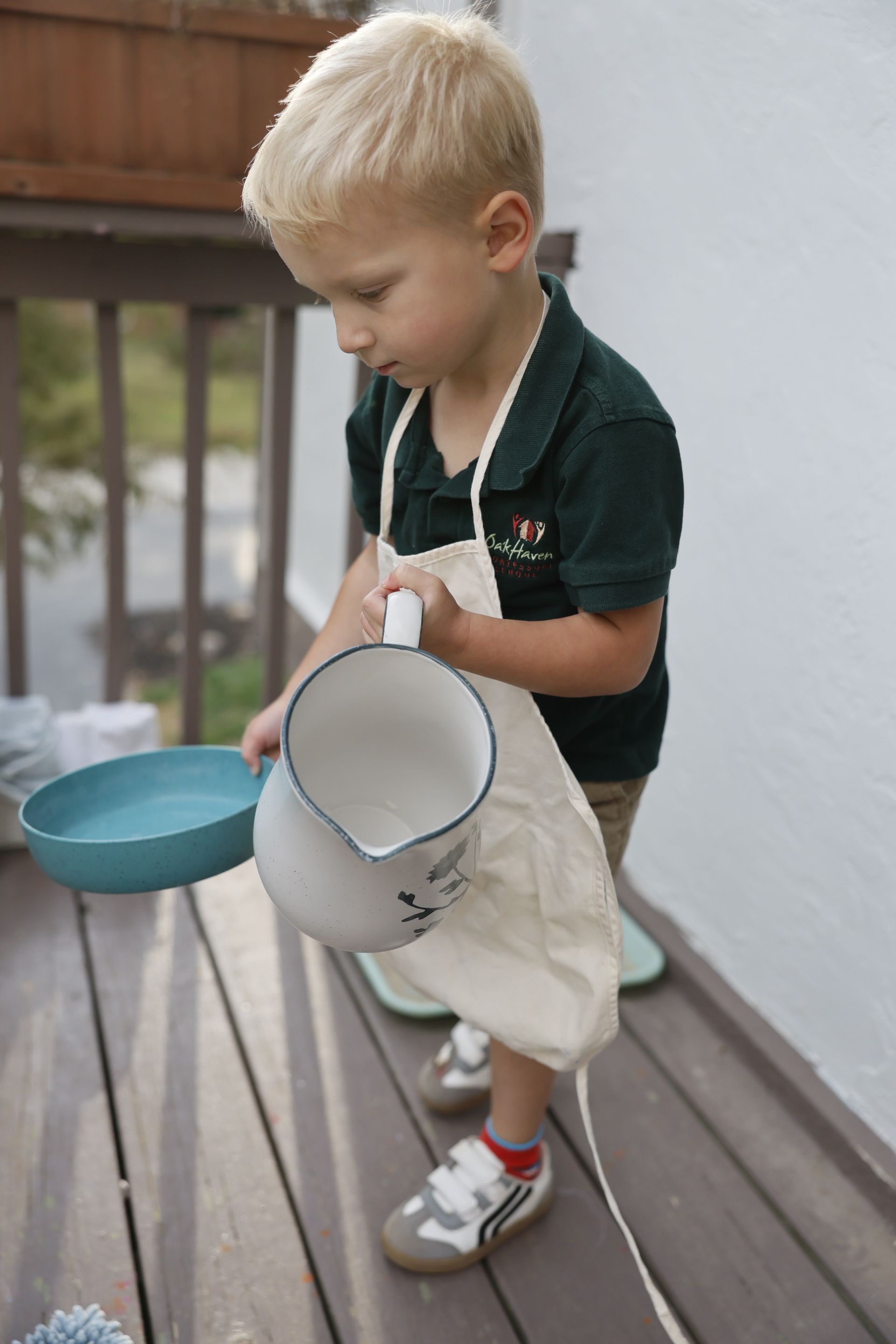
Children possess an innate radar for authenticity; they know the difference between pretend play and real contribution. In a Montessori environment, we do not provide toy brooms or fake kitchens. We provide real, functional, child-sized tools.
If the plants on our windowsills are dry, the children water them using a small metal watering can. If a window is smudged, they use a small squeegee to clear it. Because these actions have a visible, genuine impact on their surroundings, the children develop a profound respect for their physical environment and a deep connection to their peers.
Bringing Practical Life into Your Home Rhythm
Families in our Dardenne Prairie and St. Charles County communities frequently ask how they can mirror this meaningful work at home. Fortunately, it does not require elaborate layouts or specialized materials. A few intentional adjustments to your home environment can beautifully support your child's independence:
- A low basket in the bedroom for dirty laundry.
- A dedicated drawer in the kitchen containing child-safe placemats and utensils so they can independently help set the family table.
- Accessible cleaning tools, like a small hand-dustpan and brush stored on a low hook, allowing them to happily sweep up their own crumbs after breakfast.
When considering how to invite your child into a new household routine, it can be helpful to keep these simple guiding questions in mind:
- Can this activity be done safely and independently by the child?
- What specific step-by-step skills do I need to show them first?
- Does this setup allow for the child to repeat the activity if they wish?
- Is the tool child-sized, functional, and beautiful to look at?
The Joy of Purposeful Work
When children learn to care for themselves and their surroundings, they discover just how truly capable they are. They internalize logical sequences, refine their gross and fine motor coordination, and experience a deep satisfaction that comes from the process itself, rather than just the final product.
Through Practical Life, children build the foundational confidence required to step into their fullest, most independent selves.
If you are curious to see how these daily rhythms of independence come alive in a classroom setting, we would love to welcome you into our school.
Partner With OakHaven: We love collaborating with families to support the whole child's development. If you are exploring an authentic Montessori education for your child, please feel free to reach out to our team to learn more about our programs and community life.