August 31, 2026
You know that Montessori classrooms are different from traditional school settings. If you have been researching local options in St. Charles County, you may have even encountered a few of the common myths: that children run around doing whatever they please without structure, or conversely, that the environment is so rigid it stifles natural childhood creativity.
What is it really like inside our walls?
We can practically guarantee that once you step inside our school, sit quietly in an observation chair, and watch the children and adults at work, your impressions will be transformed. In the meantime, this post will give you a clear window into what you will see on a typical day at OakHaven Montessori School.
The Arrival Rhythm
From the moment they step through our doors in Dardenne Prairie, expectations are beautifully distinct for our students. Children are responsible for hanging their own bags and coats on low hooks. The Elementary children learn to change into indoor shoes, a standard practice that serves two purposes: it keeps our workspaces clean, and it signals to the child's brain that they have entered a comfortable, focused, home-like space.
Our Guides (teachers) make a point of greeting each student individually upon arrival. They look them in the eye, shake their hand or offer a warm greeting, and speak their name. By starting the morning this way, we are intentionally modeling polite, respectful human interaction. Before long, the children internalize this grace and courtesy, confidently greeting us back and applying these social skills out in the wider world.
The Morning Work Cycle
The cornerstone of the Montessori day is the uninterrupted morning work period. We know that children require deep, sustained stretches of time to immerse themselves in independent work. Rather than fracturing their day with artificial 45-minute subject bells, we honor their natural psychological focus by protecting this block of time.
For our Primary students (ages 2.5 to 6), this uninterrupted cycle lasts up to three hours. Our Elementary students follow a similar morning rhythm, often balanced by a second productive work period in the afternoon.
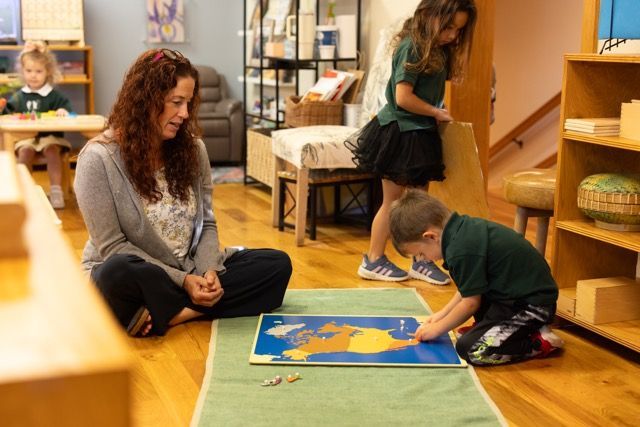
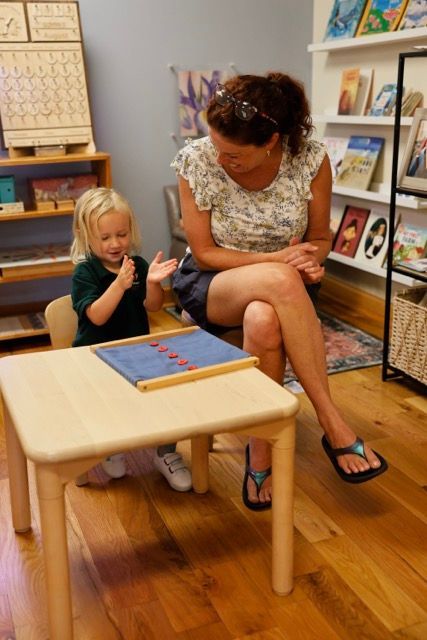
During this time, children choose their own work independently while the Guide moves quietly through the room giving precise, individualized lessons. To an outside observer, it might look like a child is simply playing. However, Dr. Montessori designed these materials to satisfy a child's deep developmental needs. What looks like a beautiful wooden puzzle is actually a multi-layered botanical diagram. What looks like an attractive set of colored beads is a concrete tool for exploring complex algebraic or mathematical concepts.
Because we respect children as capable individuals, they are granted vital structural freedoms during the work cycle:
- Freedom of Movement: Children may stand, stretch, walk to a window, or use the restroom when their bodies dictate, without needing adult permission.
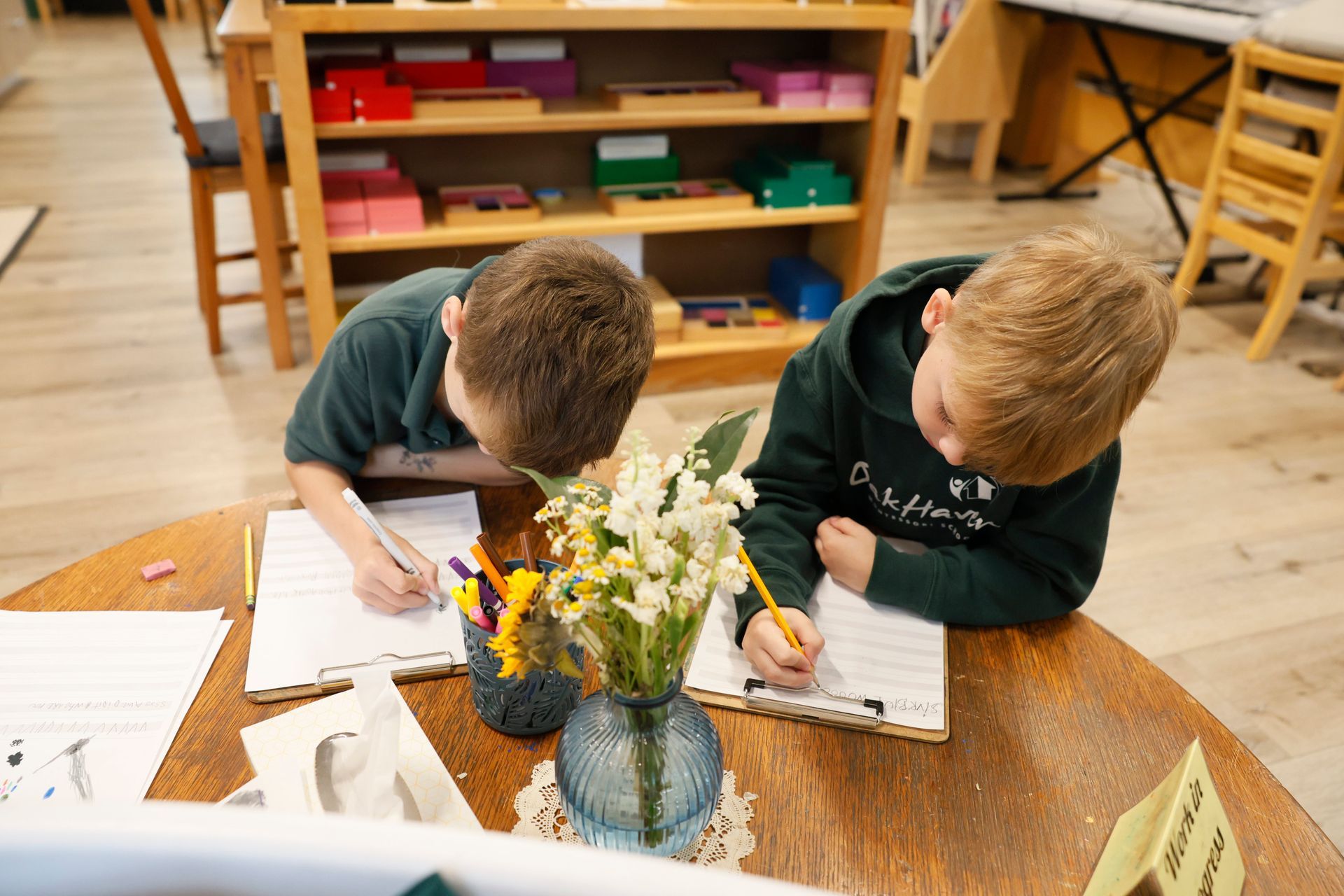
- Flexible Seating: Students choose where to work—some prefer a low table, while others lay out a small work rug on the floor to define their space.
- Varied Subject Matter: On any given morning, a single room will display children simultaneously working across math, language, biology, geometry, geography, and practical life skills.
Supporting the Social Self
Nurturing the whole child is a popular phrase in modern education, but our multi-age environments have concrete structures built directly into the curriculum to support a child's social development.
Because our classrooms span a three-year age mix, children naturally learn how to navigate a real community. Rather than assigning seats or forcing arbitrary group work, we allow children to choose whether they want to work independently or cooperatively, and with whom. Our Guides gently assist them in discovering the difference between a productive work partner and a wonderful, playful friendship that can be further enjoyed during outdoor play.
As children enter the Elementary years (ages 6 to 12), their developmental focus shifts heavily toward peer relationships. Figuring out what a healthy community looks and feels like is the major psychological work of this stage. Naturally, this exploration includes navigating social conflicts.
One of the greatest benefits of an AMI environment is that our Guides possess the time and training to help children navigate these moments constructively. We teach real mediation strategies, inclusivity, and proactive conflict resolution. Through storytelling and neutral role-playing, children learn to step outside their immediate emotions and evaluate positive approaches to resolving daily peer dilemmas.
The Role of the Guide
Perhaps the most surprising element for first-time visitors is the role of the adult. We refer to our classroom leaders as Guides rather than teachers, as it is a far more accurate description of their work. Instead of standing at a blackboard feeding children a uniform stream of information, our Guides observe the unique development of each individual, opening doors to new concepts when the child is developmentally ready.
In the Primary years, lessons are almost exclusively given one-on-one. This allows the Guide to give their absolute, undivided attention to the child before them. In the Elementary years, matching the child's changing social drives, lessons are typically presented to small, collaborative groups.
The delicate art of the Montessori Guide lies in knowing exactly when to step in and assist, and when to step back and allow a child to struggle productively toward their own solution. We firmly believe that children are capable of far more than modern culture often credits them for. When given the space to solve their own problems, they build authentic resilience and lasting internal confidence.
Finally, the Guide is a scientific observer. We take meticulous notes on which skills a child has mastered, where they are progressing, and where they might need a new presentation. We are not the center of the classroom; we are the dynamic link between the child and the prepared environment.
See Our Environments in Action
The unique magic of an authentic classroom cannot be fully captured on a screen or a page. It must be felt. We highly encourage families to join us for a morning observation to see this peaceful, industrious rhythm with their own eyes.
Schedule an Observation: If you are exploring programs for your child and would like to experience the OakHaven difference firsthand, we welcome you to schedule your personal tour today.