September 7, 2026
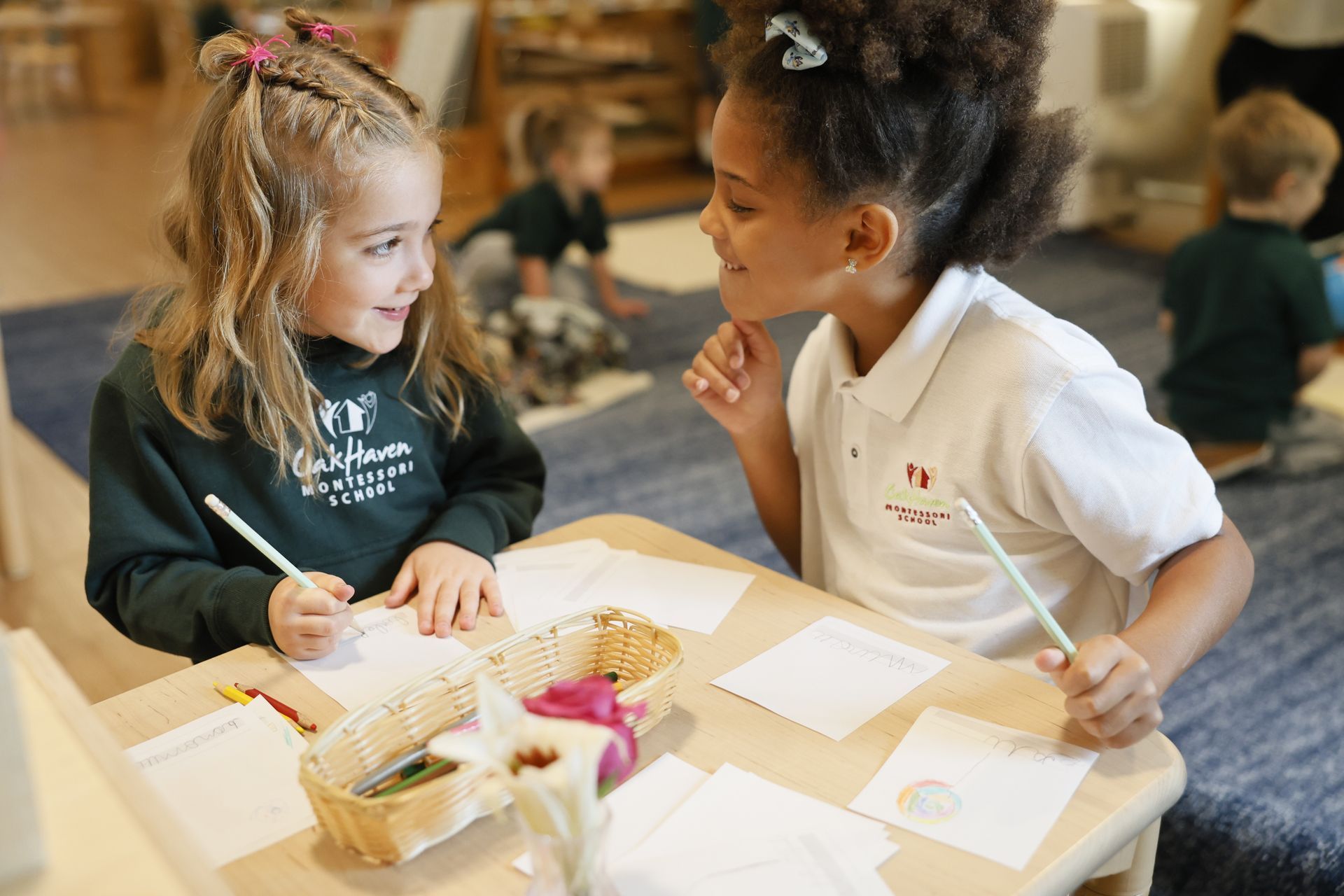
Our ability to communicate through language is a core part of what makes us human. Language binds our communities together, deepens our relationships, and provides the foundation for collaboration and mutual understanding.
Long before a child speaks their first clear word, a quiet, powerful process of development is taking place. In Montessori education, we view language not just as a tool for speech, but as a primary path through which the child constructs their mind and understands their world. This incredible foundation begins before birth and unfolds rapidly during the first three years of life.
Prenatal Through Birth: The Earliest Listening
A baby’s auditory system begins functioning early in development, around 13 to 14 weeks in utero. Long before entering the world, an unborn baby is listening to the rhythm and cadence of speech.
Talking, singing, and reading to a baby while in utero provides familiar points of comfort after birth and offers early opportunities to develop auditory discrimination. After birth, a newborn naturally recognizes their mother’s voice and shows a clear preference for human speech over background noise. From day one, a baby's brain is naturally wired to perceive, categorize, and seek out the distinct sounds of human language.
Two to Three Months: The First Dialogue
During the first few months, a baby’s cry is their primary mode of communication. Around two to three months of age, subtle physical developments allow babies to begin modulating their vocalizations.
By three to four months, you will hear delightful experimentation: cooing, gurgling, and warm vowel sounds. When adults respond to these early vocalizations with genuine interest and eye contact, a true back-and-forth dialogue begins. This early exchange gives the baby feedback and communicates a vital message: your voice matters, and we are listening.
Five to Seven Months: Exploring Sounds and Sequences
As physical development progresses, babies begin pairing consonants with vowels. Between five and seven months, sound play becomes a joy in itself. The child is no longer just expressing physical needs; they are actively testing out sequences of sounds.
By seven to eight months, rhythmic babbling emerges ("ba-ba", "da-da"), and by the end of the first year, these sequences begin to mirror the rhythm and intonation of full sentences. Babies also discover that certain sound combinations bring joyful responses from the adults around them.
Beyond producing sounds, the child is learning that sounds carry meaning. By nine months, babies are tuning into patterns in spoken language, recognizing consistent sequences of sound within the daily rhythm of their home.
Nine to Twelve Months: Intentional Communication
From nine to twelve months, children enter a dynamic stage. They begin identifying specific words in daily conversation, expressing a strong desire to share experiences, and preparing to pronounce their first true words.
During this phase, a child’s receptive language (what they understand) is far ahead of their expressive language (what they can say). A child might use a single word repeatedly to mean several different things.
Our response as adults during this window is deeply meaningful. When we follow the child's lead, acknowledge their intent, and respond to what holds their interest, we validate their efforts and give them the confidence to keep communicating.
"Babies at nine months whose mothers followed the baby’s lead, who responded to what the baby was interested in, had larger comprehension vocabularies at thirteen months."
— How Babies Talk: The Magic and Mystery of Language in the First Three Years of Life
12 to 20 Months: The Language Explosion
Between 12 and 20 months, vocabulary grows at a remarkable pace. While new words may accumulate slowly at first, children soon reach a tipping point where new words emerge almost daily.
Once a toddler masters roughly 50 words, their vocabulary truly takes flight. Around 18 to 20 months, children experience a massive influx of nouns, verbs, prepositions, and adjectives. A toddler at this stage may acquire up to nine new words a day!
During this window, children also begin sorting concepts. They learn that "leaf" applies to maple leaves, oak leaves, and willow leaves alike, demonstrating an early capacity for categorization and abstract thought.
20 to 36 Months: Expressing Self and Connecting with Others
As toddlers approach age two and head toward three, simple phrases evolve into complex sentences. Children begin using language to describe not only their physical surroundings, but also their internal feelings and choices.
A significant milestone occurs when a child transitions from referring to themselves in the third person ("Maya want water") to the first person ("I want water"). This linguistic shift reflects a growing self-awareness and independence.
Partnering with the Developing Child
While every child develops along their own unique timeline, this sequence of language acquisition is a universal human journey. The speech environment we provide in these first three years, offering clear spoken language, rich vocabulary, patient listening, and genuine conversation, serves as the foundation for all future learning.
At OakHaven Montessori School, our Primary environments (serving children ages 2.5 to 6) are thoughtfully prepared to support and refine this exploding capacity for language. Through precise vocabulary, storytelling, conversation, and hands-on phonetic materials, Guides (teachers) partner with each child to help them express their thoughts with clarity and confidence.
Curious to see how a rich language environment supports your child's natural development?
We invite you to
schedule a tour and observe our environments in action. Contact our team today to learn more about our Primary and Elementary programs.